Showing posts with label race. Show all posts

Wednesday, December 8, 2010

Martin Luther King Jr. & Harvey Milk


I happened to be thinking about Martin Luther King Jr. and the way the contributed so much to the African American civil rights movement when I asked myself: who is the Martin Luther King Jr. of the gay civil rights movement? The first name that immediately popped into my mind was that of Harvey Milk. I decided to do some research on the two and see how many similarities the shared. I came upon a very interesting blog. To check it out click here.

Abolish the "N" word

Throughout the semester we have been discussing the wrongful use of the word gay to mean bad or something similar. However, a similar word that we haven’t talked about is the “N” word. To this day the “N” word is still tossed around like nothing regardless of the historical significance it has. Since we hadn’t talked about it much in class I decided to do some research on it and I found a great site with plenty of information. This is the site of an organization whose mission is to abolish the “N” word. When you first open the site you’ll see a great introduction with really strong images and phrases. It really makes you think about why we still use the “N” word. Then you go on to the main page where you can find out more about the organization, its mission, and its history. You can also join its mailing list and learn more about it. Click here to check it out.

Monday, November 8, 2010

Lecture Notes: Gender & Marriage (Baehr v. Lewin)

Here are some of my lecture notes for today's class summarizing some of the ideas and questions that are in play in the discussion of Gender & Marriage: Baehr v. Lewin. Many of these ideas are taken or adapted from William Eskridge's The Case For Same-Sex Marriage.

We shall be discussing the construction of gender and sex today, in the context of marriage law.  The cases we will be dealing with are Baehr v. Lewin, Singer v. Hara, Zablocki v. Redhail and Turner v. Safely, and, of course, Loving v. Virginia. We shall be analogizing the scientific and social construction of sex and gender with the irrational and sometimes confusing construction of race. However, by looking at the differences in the way that the law has treated interracial marriage from the way it has treated homosexual marriage we will expose and analyze scripts based on these two reified characteristics: race and gender.

For example, just as we ask ourselves "What is the purpose behind anti-miscegenation law?" we should also ask ourselves "What is the purpose behind the ban on same-sex marriage?" Happily, we have the texts of numerous legal decisions in both areas which give us a number of opportunities to analyze the scripts of race and gender.

Today we will be discussing how the motives and beliefs behind gender discrimination are concomitant with the motives and beliefs which lead to sexual orientation discrimination. Similar to the way in which we discussed how ideologies of race were played out in the area of miscegenation law one of the useful ways to consider "cultural ideologies associated with sex" (which we call gender) is also through the examination of marriage.

First let's consider the difference between gender and sex. Sex is what we call the characteristic which differentiates between 'male' and 'female.' Gender is what we call the cultural and societal associations aligned with sex. How do different characteristics get assigned to (biological) sex as opposed to (cultural) gender? In other words, what are the biological features of sex which "matter"?
If we have established that there is a "gender line" which separates masculine from feminine similar to the "color line" which separated White from non-White how is this demarcation regulated? What forces determine that this line is not crossed?
What sanctions occur if the boundaries of appropriate gender expression are breached? How are these different for the sanctions for crossing the "color line"?

In particular we are trying to see if we can identify similarities (and differences) between how race and gender are constructed by marriage and law. In the case of race, marriage is used as a regulatory device of the "purity" of the race; it maintains the dividing line between White and Other. In this case the dividing characteristic, race, is a cultural construct, irrationally derived from alleged biological differences which, when examined, are hard to justify. In the case of gender, how is marriage used as a regulatory device of the difference between the hegemonic and subaltern halves of the gender binary? What  are the (historical) rationales behind maintenance of the color line and (the current and future) reasons for the maintenance of the gender line?

We have already established that governmental classifications based on gender need to reach an "exceedingly persuasive" standard of heightened scrutiny in order to survive. A number of sex discriminatory laws by the State have been invalidated since the 1970s. Prior to 1970, laws which classified by sex or gender were routinely upheld. Currently, there are a number of ways in which the Government maintains classifications based on sexual orientation and discriminates against the class of lesbians and gay men. Classifications based on sexual orientation are not "suspect classifications," but merely receive rational basis scrutiny by Courts. 

Sometimes it is difficult to differentiate between sex and sexual orientation classifications. In fact, some people would argue that these two ideas are inextricably linked. Professors Andrew Koppelman and Sylvia Law have been in the vanguard of recognizing the intersection of sexuality and gender discrimination. This interesting theoretical notion has gained currency recently through the Hawaii State Supreme Court's ruling in Baehr v. Lewin that the state marriage law preventing same-sex couples to be issued marriage licenses violates the Hawaii state constitutional ban on sex discrimination. Even though the classification is based on sex, the class that is discriminated against is lesbians and gay men.


In the Hawaii marriage case one of the main arguments is that the nature of the current Hawaii marriage law is not a sex classification, but a sexual orientation classification. What difference does it make? What does this say about the way that law functions that this point is one of the main areas of contention? 


Below are summaries of the cases involved

Loving v. Virginia (1967) 
The United States Supreme Court invalidated Virginia's prohibition of different-race marriage as a violation of both the equal protection and due process clauses. The decision explicitly overruled Pace v. Alabama (1883 case in which the Court upheld a statute which criminalized interracial adultery more harshly than homoracial adultery). In defense of its anti-miscegenation law, Virginia cited the disapproval of different-race marriage by religious and moral traditions. The Court rejected this argument and characterized the statute as a "repugnant" attempt to "maintain White Supremacy." This decision initiated the "right to marry" line of cases (followed up in Zablocki and Turner)..

Baehr v Lewin (1993) 
The Hawaii State Supreme Court held that the state's denial of marrriage rights to same-sex couples is sex discrimination under the state constitution's equal rights amendment and remanded the case for trial to determine whether the discrimination could be justified by a compelling state interest. In December 1996, a Hawaii Trial Court found in Baehr v. Miike that the state's interest in supporting the upbringing of children in particular kinds of households uncompelling and ruled that Hawaii must begin issuing marriage licenses regardless of gender. The judge then granted a stay on his decision until the Hawaii Supreme Court could rule on the state's appeal. Before the Hawaii Supreme Court could rule the voters of Hawaii amended their constitution to empower their legislature to restrict marriage to mixed-sex couples, thus voiding the Baehr lawsuit.
Singer v. Hara (1974) 
The Washington State Court of Appeals upheld against both state and federal constitutional attack Washington's denial of marriage rights to same-sex couples. The court both denied that the marriage law involved a sex classification and used a definitional argument to exclude same-sex couples from the institution of marriage. This was the first reported case to reject an argument that denying same-sex couples the right to marry is sex discrimination in violation of the state constitution's equal rights amendment.
Zablocki v. Redhail (1978) 
The Court invalidated Wisconsin's bar to remarriage when one partner has unpaid support obligations from a previous marriage. Emphasizing the state's interference with Loving's right to marry, the Court held that the law violated the equal protection clause by discriminating in the allocation of this fundamental right.
Turner v. Safely (1987) 
The Court invalidated Missouri's almost complete bar to marriage by prison inmates. Although the Court deferred to state rules regulating prisoners, it held that denial of the right to marry requires more rigorous justification because the unitive and legal features of marriage are so fundamental in our polity. 
    Here are some discussion questions to consider
  1. How is marriage essentialized (i.e. what features of marriage are said to be essential to it in order for it to be called a marriage) in order to maintain the ban on interracial marriage? How is marriage essentialized to maintain the ban on same-sex marriage?
  2. What characteristics does the United States Supreme Court ascribe to marriage in Zablocki and Turner? What impact does the USSC's characterization of marriage have on the question of same-sex marriage?
  3. Contrast the language judges use in upholding bans on same-sex marriage to the language used in upholding bans on interracial marriage. Are there similarities? differences?
  4. How are constructions of race and gender (through law and marriage) both similar and different?
  5. When the USSC holds that the ban on interracial marriage is really a measure to "maintain White Supremacy" what "ideology of race" (Pascoe) are they adopting?
  6. What ideology of gender does the current ban on same-sex marriage enforce or promote?
  7. Try to form an analogy between Haney Lopez' arguments about Whiteness and a corresponding argument about Maleness. Can you do so? In what contexts does the analogy 'work'? In which contexts does it not work?
  8. In what ways does The Law deal with gender differences differently than it deals with racial differences? Think of some explanations for the differences. Identify some similarities.

Friday, October 1, 2010

Race Relations, LeBron James, and Black Protectionism


Yesterday I went about my day as normal and looked at ESPN. The news was typical, College and NFL talk, the MLB Playoff races, and as usual LeBron James and his new team the Miami Heat. In case you ddi not already know former Cleveland Cavalier superstar basketball player LeBron James abandoned his team to join fellow superstars Dwyane Wade and Chris Bosh in Miami over the summer in hopes of winning a championship. He announced his decision on an hour long ESPN television special known as "The Decision", which many people and I found to be repulsive, uncourteous, and completely unnecessary (although I am satisfied he gave the proceeds earned by the special to charity). As a result of his decision to leave his hometown of Cleveland, which worshipped and deified him, LeBron has been taking negative backlash throughout the basketball fan community, especially in the city he once played for.

However, I saw an article mentioned on SportsCenter written by an ESPN sportswriter named Vincent Thomas. It is titled LeBron James and Black Protectionism. The concept of "Black Protectionism" is intriguing because for the most part it is valid. LeBron is one of the most hated athletes after Kobe, Tiger Woods, Chad Ochocinco, T.O, and Michael Vick (note what's in common with these guys) according his Q Score. However, a further in depth study reveals that blacks remained for the most part neutral in their stance against LeBron while non-blacks scores revealed a higher level of disdain against the former King. Vincent Thomas argues that the African American people has historically been supportive of black athletes because they are role models within the Black community. He further explains that while black people will feel angry against LeBron for his decision, they do not feel total resentment against him.

For the most part this argument of Black Protectionism is true and while I cannot and will not speak on behalf of the African American community, I personally feel the same way Thomas does and most of the black people I know does too. Take for example the case with Michael Vick, who after he got convicted of dog fighting and served jail, became vilified by the media. I personally was disgusted by this revelation but I did not hate Mike Vick and no black friend or person I knew and talked to hated him either. In fact, we felt sorry for him and we wanted him to have a change of character as well as a second chance in his career after he served his time. It's the same with Tiger Woods; we were disgusted by his adulterous affairs but I and the black people I knew did not hate or vilify the golfer. We also wanted him to continue his successful career while hoping he had changed.

Ultimately, vilification comes down to the name and the talent: LeBron is the most talented basketball player in the NBA. Had this been another talented player like Chris Bosh (his fellow teammate) or Carlos Boozer, they would not have received as much negative attention simply because they are not better or more marketable than LeBron. However, as LeBron continues to receive disdain and hatred by the non-black populace, racist intent or otherwise, the Black community will continue to stand by James' side as he continues an illustrious career in South Beach.

Thursday, September 30, 2010

What an increasing number of interracial citizens means

An article in the LA Times writes about how the emergence of an increasing interracial population may bring the end of identity politics. 


I looked up the term "identity politics" on the Stanford Encyclopedia of Philosophy where it defines it as meaning "a wide range of political activity and theorizing founded in the shared experiences of injustice of members of certain social groups" or, as WiseGeek said in a much simpler way, it is "when members of a specific subgroup unite in order to affect political or social change."


The author writes that the upcoming generation could have as many as 1 in 7 interracial children, or on the western states, as many as 1 in 4. This new generation will "find itself at odds with America's divisive identity politics" and could end these politics by, instead of becoming part of an existing subgroup, finding a different, less divisive way to get involved with issues. 

I don't know if interracial people will end identity politics all together, because race isn't the only thing you can identity with and group with others on. There's also gender, sexuality, socioeconomic status, religion, geographic location, etc. I do hope, though, that it will be a beginning to "bypass[ing] labels and embrac[ing] individualism."

The author also makes another point, that people will ask his multiracial kids, "What are you?" wanting to know their specific racial makeup. He writes, "In the age of identity politics, it is not stories but race that matters." I don't know if asking "What are you?" directly correlates to identity politics, though. Some people are just curious. As a biracial person, I have never taken offense to the question, "What are you?" On a side note, some Latino people have assumed that I was also Latino and were very surprised to learn that I have not a drop of Latino blood in me. I don't find that offensive; I find that fun and, in a way, flattering. 


The author also writes about choices multiracial people have when "they enter into a world where no choice is clean-cut." I think the great thing about being multi/biracial is that you can choose whatever you want. I went through a very brief time period where I would whine about how I would never be fully accepted into white culture or in Asian culture, but my dad offered the idea that being multiracial meant that you wouldn't awkwardly stand out in any culture. You look different, but not in an obvious way. You could fit in anywhere. I like that idea much better.

Thursday, September 23, 2010

Cities Divided by Race

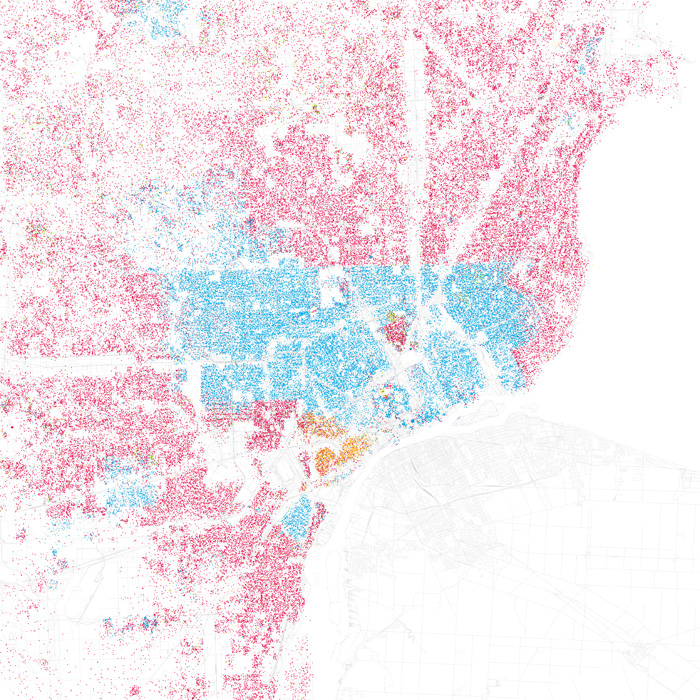
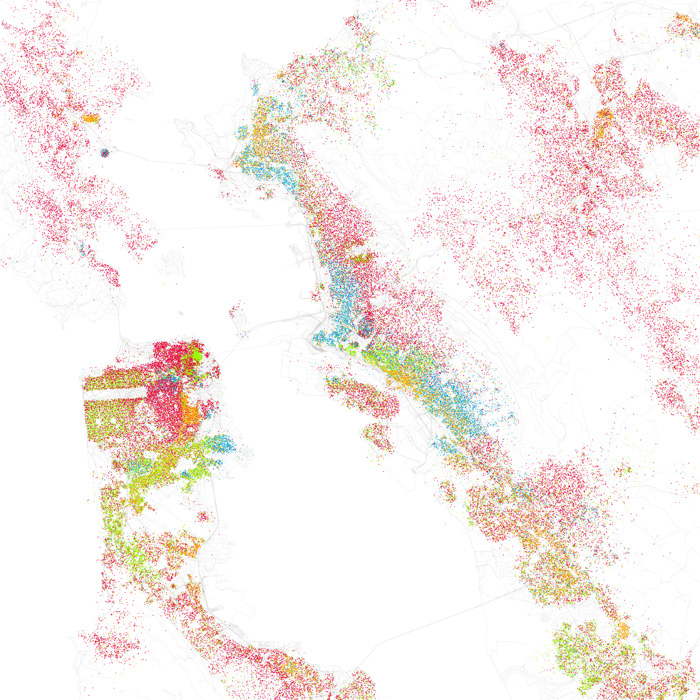
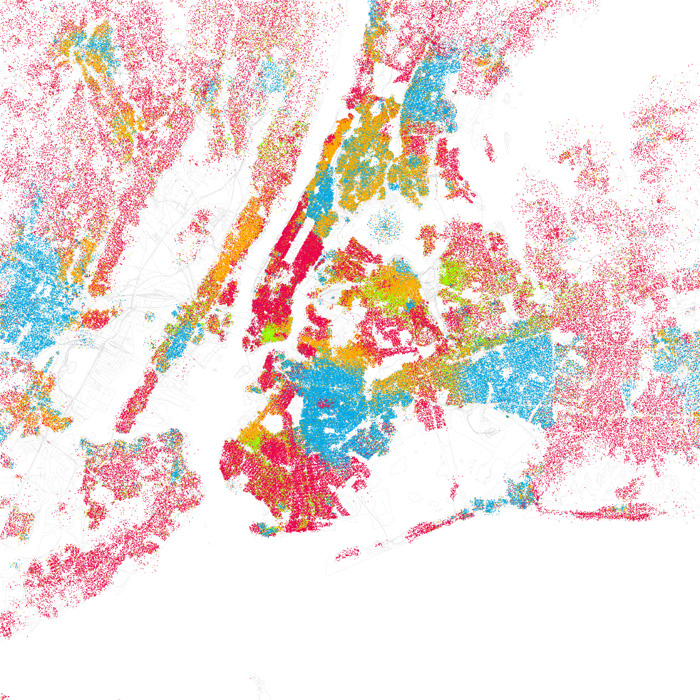
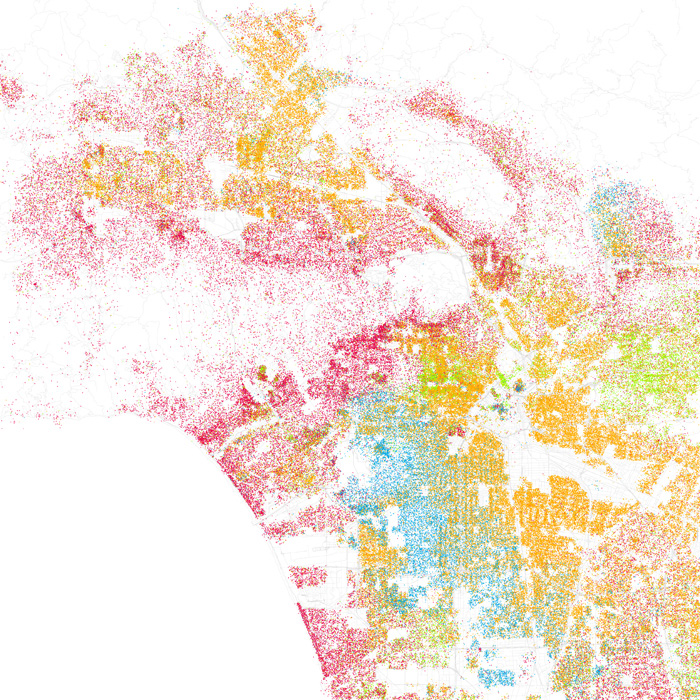
I found these images of some of the U.S.'s biggest cities and how they're racially segregated. The U.S. has comes a long way since the racism of the early 20th century and before, but as a nation, it seems that overall, we are still segregated from each other. 

One dot = 25 people

Color is based on race:
White = pink
Black = blue
Latino = orange
Asian = green

San Antonio has a majority white and Latino population. While there is still a division between the two, we can see that the two races are still pretty integrated with each other. 

(Click for a larger size.)

Washington D.C. has a clear line between white and black, but there are still some areas in the city where colors are blended, marking more racially integrated areas.


Detroit, however, is very obviously segregated, with very little racial integration. According to the website, "the infamous Eight Mile beltway... serves a precise boundary for the city's black and white populations."


It's no surprise that the San Francisco bay area is one of the most racially integrated cities. 


New York City, known for its rich cultural communities, is very divided, but according to the website, "the sheer number of people in those areas means that the boundaries become intensely rich areas of cross-cultural ferment."


And our own city of Los Angeles, widely recognized to be very racially and culturally diverse, shows off how the homogenous white race isn't the majority here.


Sunday, September 19, 2010

Discrimination Against Black Women

As I read Free Papers by Daniel J. Wideman I realized that the piece concentrated on the issue of young black men being discriminated against. Not once was discrimination against young black women mentioned. Discrimination against black women isn’t only disregarded only in this piece but in many other places in society. Since this issue is so ignored I decided to do a bit of research and find out in what ways black women were most discriminated against and how they dealt with it. I was also curious to learn if they were more heavily discriminated against than black men because of their gender.

The most useful and informational article that I found was Black Women: The Unfinished Agenda by Cecilia A. Conrad in The American Prospect. This article explained how black women are discriminated against both because of their race and gender. Hence, even though black women have advanced so much in the fields of education they still earn less than black men, white women, and white men. The unemployment rates are also a lot higher for black women than all the previous categories mentioned. The article goes on to explain the detrimental effects of discrimination against black women. It’s a very interesting and enlightening article, I recommend everyone to read it.

Friday, September 10, 2010

What we learn is actually relevant! (in the Buffyverse, anyway)

Before CSP19 today, I was reading a book I picked up at the library last night. This book is called Girls Who Bite Back. The specific chapter I was reading was called " 'Cuz the Black Chick Always Gets It First" by Candra K. Gill. The parallels between this chapter and the discussion we had in class were amazing, in my opinion. The topic that stuck out the most was the assimilation of a black girl to the white town of Sunnydale, CA.

In the book, it is stated that "[Kendra] is a young black woman who speaks in what sounds like a Caribbean accent. ... By the time she leaves Sunnydale to return to her Watcher, she has become more like Buffy, which is presented as a positive change." Basically, Kendra has a complete personality makeover, because she was originally the exact opposite of Buffy and then one episode later, she becomes much more like Buffy than would have been believable. Kendra is representing the "Model Minority." She is black and speaks with a Caribbean accent, and thus would never be able to fully assimilate with American culture. So rater than make her a strong but different character, the show turned her into an almost Buffy. Essentially, they made her into THE model minority.

Thursday, September 9, 2010

Race: The Power of an Illusion


We're going to watch a clip from the PBS documentary Race: the Power of an Illusion in Friday's class as we discuss how race is a social construction, especially in the legal sphere. You should read both articles by Law Professor Ian Haney López (White By Law, The Social Construction of Race). You might want to check out other clips from this excellent documentary on the web.


I'm looking forward to multiple comments from students on this topic!

Realizing Race is a Social Construct

For the first page or two of this paper, I scratched my head every time the author said that people didn’t know how to truly define race. Isn’t it obvious? Black, white, Asian... how else can you define it? When he did finally explain what race actually is by writing that it is “an ongoing, contradictory, self-reinforcing, plastic process subject to the macro forces of social and political struggle and the micro effects of daily decisions,” I wrote a big, bold, frustrated “What?” next to the sentence. In my mind, it was obvious that we were all divided by race. Looking around in LA, you can see how divided the races can be, such as the mostly Latino community of Highland Park and the predominantly Asian city of San Marino.
It wasn’t until I read, “There are no genetic characteristics possessed by all Blacks but not by non-Blacks,” that it finally clicked in my head. Duh! Obviously our DNA and genes are not necessarily specific to and determined by our ancestral backgrounds and the color of our skin. Society has conditioned us to believe that our behavior, thoughts, actions, and beliefs are linked to our race. But the divisions that I had been assuming were about race have nothing to do with race at all; it’s about culture. For example, it’s not because you’re of “Korean/Asian race” that you are familiar with kimchi and watch dramatic Korean dramas. It’s because you were raised with Korean culture in the home. The thing that can and does separate some of us is culture, not race. Of course, there are other things that can separate us, too, like our gender, sexual orientation, class, etc., but those are also all different types of cultures. And what is culture but a construct of society?

Tuesday, September 7, 2010

Let's Talk About Race -- Tricia McGown

Is this joke funny?

*Warning. This joke contains racially insensitive material.*
http://stroganoff.tumblr.com/post/1062186845
(This is where I found the "joke.")

This is a spoof on the childhood joke that goes as follows:
Why was six afraid of seven? Because seven eight nine.

However, this joke is offensive. I found multiple comments on this joke talking about how funny it was and how hilarious this is, especially because of its stereotypical nature. Notice that seven has a bucket of KFC in one hand, a television in the other, and is almost impossibly "black." His skin is very, very dark, and six is looking at him with a mixture of what looks like confusion and disdain.

My question, I suppose, is not "Why does this image exist?" It exists because there is still racism in the world, no matter how much we'd like to deny it. My question is "Why should we fear blackness, or African-Americans?" Is there something inherently frightening about African-Americans that makes them subject to being the butt of jokes like these? I suppose the same answer could stand and that we can say that we fear African-Americans because this is a racist society that we live in today, but I feel as if that's a cop out. After reading Wideman's "Free Papers," I've started to see more clearly the fact that race does still play an important part in society. Sure, the article may not have been written a month or even a year ago, but there are parts of it that still ring true today, unfortunately.

This joke isn't going to make or break the world, but I had to stop and think when I saw it. What about you?