This one's just kind of confusing, but I think it might be a good thing.
A recent study done surveyed the television preferences of people on the basis of their political standing, and here's an interesting fact: among typically anti-gay Republicans' favorite shows is ABC's comedy "Modern Family," which if you don't know it, features a gay couple with an adopted Vietnamese daughter among its characters.
Wait, what?
Okay, to be fair, Modern Family features a very large family made up of three separate households: the aforementioned gay couple and their daughter, a traditional American household with a loving husband and wife and three children, and an older man (the father of one of the members of the gay couple and of the wife in the traditional household) who remarried to a somewhat younger Colombian woman with a son from her first marriage. As explained to me by my sister's communication's professor (I was interviewing her about television for a school project) it presents lots of different options and lets the viewer decide which ones they like in order to appeal to a wide demographic. But still, it's interesting that a show acknowledging the presence of many alternative lifestyles makes it into the top TV picks of Republicans. What pleases me about this is the idea that the supposed best way to convince people to join a pro-gay rights stance is by them getting to know a gay person. Although fictional characters are no substitute for reality, and may not actually have any effect whatsoever, at least Republicans are getting exposed to the idea. Mitch and Cameron, the couple in question, have realistic concerns in a realistic life, and Mitch isn't even a stereotypical gay man. Maybe seeing that will help people come around to the idea that there is no such thing as a secret gay agenda.
Showing posts with label homosexuality. Show all posts
Showing posts with label homosexuality. Show all posts
Saturday, November 20, 2010

Monday, November 8, 2010
Lecture Notes: Gender & Marriage (Baehr v. Lewin)
Here are some of my lecture notes for today's class summarizing some of the ideas and questions that are in play in the discussion of Gender & Marriage: Baehr v. Lewin. Many of these ideas are taken or adapted from William Eskridge's The Case For Same-Sex Marriage.
In the Hawaii marriage case one of the main arguments is that the nature of the current Hawaii marriage law is not a sex classification, but a sexual orientation classification. What difference does it make? What does this say about the way that law functions that this point is one of the main areas of contention?
Below are summaries of the cases involved
We shall be discussing the construction of gender and sex today, in the context of marriage law. The cases we will be dealing with are Baehr v. Lewin, Singer v. Hara, Zablocki v. Redhail and Turner v. Safely, and, of course, Loving v. Virginia. We shall be analogizing the scientific and social construction of sex and gender with the irrational and sometimes confusing construction of race. However, by looking at the differences in the way that the law has treated interracial marriage from the way it has treated homosexual marriage we will expose and analyze scripts based on these two reified characteristics: race and gender.
For example, just as we ask ourselves "What is the purpose behind anti-miscegenation law?" we should also ask ourselves "What is the purpose behind the ban on same-sex marriage?" Happily, we have the texts of numerous legal decisions in both areas which give us a number of opportunities to analyze the scripts of race and gender.
Today we will be discussing how the motives and beliefs behind gender discrimination are concomitant with the motives and beliefs which lead to sexual orientation discrimination. Similar to the way in which we discussed how ideologies of race were played out in the area of miscegenation law one of the useful ways to consider "cultural ideologies associated with sex" (which we call gender) is also through the examination of marriage.
First let's consider the difference between gender and sex. Sex is what we call the characteristic which differentiates between 'male' and 'female.' Gender is what we call the cultural and societal associations aligned with sex. How do different characteristics get assigned to (biological) sex as opposed to (cultural) gender? In other words, what are the biological features of sex which "matter"?
If we have established that there is a "gender line" which separates masculine from feminine similar to the "color line" which separated White from non-White how is this demarcation regulated? What forces determine that this line is not crossed?
What sanctions occur if the boundaries of appropriate gender expression are breached? How are these different for the sanctions for crossing the "color line"?
What sanctions occur if the boundaries of appropriate gender expression are breached? How are these different for the sanctions for crossing the "color line"?
In particular we are trying to see if we can identify similarities (and differences) between how race and gender are constructed by marriage and law. In the case of race, marriage is used as a regulatory device of the "purity" of the race; it maintains the dividing line between White and Other. In this case the dividing characteristic, race, is a cultural construct, irrationally derived from alleged biological differences which, when examined, are hard to justify. In the case of gender, how is marriage used as a regulatory device of the difference between the hegemonic and subaltern halves of the gender binary? What are the (historical) rationales behind maintenance of the color line and (the current and future) reasons for the maintenance of the gender line?
We have already established that governmental classifications based on gender need to reach an "exceedingly persuasive" standard of heightened scrutiny in order to survive. A number of sex discriminatory laws by the State have been invalidated since the 1970s. Prior to 1970, laws which classified by sex or gender were routinely upheld. Currently, there are a number of ways in which the Government maintains classifications based on sexual orientation and discriminates against the class of lesbians and gay men. Classifications based on sexual orientation are not "suspect classifications," but merely receive rational basis scrutiny by Courts.
Sometimes it is difficult to differentiate between sex and sexual orientation classifications. In fact, some people would argue that these two ideas are inextricably linked. Professors Andrew Koppelman and Sylvia Law have been in the vanguard of recognizing the intersection of sexuality and gender discrimination. This interesting theoretical notion has gained currency recently through the Hawaii State Supreme Court's ruling in Baehr v. Lewin that the state marriage law preventing same-sex couples to be issued marriage licenses violates the Hawaii state constitutional ban on sex discrimination. Even though the classification is based on sex, the class that is discriminated against is lesbians and gay men.
In the Hawaii marriage case one of the main arguments is that the nature of the current Hawaii marriage law is not a sex classification, but a sexual orientation classification. What difference does it make? What does this say about the way that law functions that this point is one of the main areas of contention?
Below are summaries of the cases involved
Loving v. Virginia (1967)
The United States Supreme Court invalidated Virginia's prohibition of different-race marriage as a violation of both the equal protection and due process clauses. The decision explicitly overruled Pace v. Alabama (1883 case in which the Court upheld a statute which criminalized interracial adultery more harshly than homoracial adultery). In defense of its anti-miscegenation law, Virginia cited the disapproval of different-race marriage by religious and moral traditions. The Court rejected this argument and characterized the statute as a "repugnant" attempt to "maintain White Supremacy." This decision initiated the "right to marry" line of cases (followed up in Zablocki and Turner)..
- How is marriage essentialized (i.e. what features of marriage are said to be essential to it in order for it to be called a marriage) in order to maintain the ban on interracial marriage? How is marriage essentialized to maintain the ban on same-sex marriage?
- What characteristics does the United States Supreme Court ascribe to marriage in Zablocki and Turner? What impact does the USSC's characterization of marriage have on the question of same-sex marriage?
- Contrast the language judges use in upholding bans on same-sex marriage to the language used in upholding bans on interracial marriage. Are there similarities? differences?
- How are constructions of race and gender (through law and marriage) both similar and different?
- When the USSC holds that the ban on interracial marriage is really a measure to "maintain White Supremacy" what "ideology of race" (Pascoe) are they adopting?
- What ideology of gender does the current ban on same-sex marriage enforce or promote?
- Try to form an analogy between Haney Lopez' arguments about Whiteness and a corresponding argument about Maleness. Can you do so? In what contexts does the analogy 'work'? In which contexts does it not work?
- In what ways does The Law deal with gender differences differently than it deals with racial differences? Think of some explanations for the differences. Identify some similarities.
Baehr v Lewin (1993)
The Hawaii State Supreme Court held that the state's denial of marrriage rights to same-sex couples is sex discrimination under the state constitution's equal rights amendment and remanded the case for trial to determine whether the discrimination could be justified by a compelling state interest. In December 1996, a Hawaii Trial Court found in Baehr v. Miike that the state's interest in supporting the upbringing of children in particular kinds of households uncompelling and ruled that Hawaii must begin issuing marriage licenses regardless of gender. The judge then granted a stay on his decision until the Hawaii Supreme Court could rule on the state's appeal. Before the Hawaii Supreme Court could rule the voters of Hawaii amended their constitution to empower their legislature to restrict marriage to mixed-sex couples, thus voiding the Baehr lawsuit.
Singer v. Hara (1974)
The Washington State Court of Appeals upheld against both state and federal constitutional attack Washington's denial of marriage rights to same-sex couples. The court both denied that the marriage law involved a sex classification and used a definitional argument to exclude same-sex couples from the institution of marriage. This was the first reported case to reject an argument that denying same-sex couples the right to marry is sex discrimination in violation of the state constitution's equal rights amendment.
Zablocki v. Redhail (1978)
The Court invalidated Wisconsin's bar to remarriage when one partner has unpaid support obligations from a previous marriage. Emphasizing the state's interference with Loving's right to marry, the Court held that the law violated the equal protection clause by discriminating in the allocation of this fundamental right.
Turner v. Safely (1987)
The Court invalidated Missouri's almost complete bar to marriage by prison inmates. Although the Court deferred to state rules regulating prisoners, it held that denial of the right to marry requires more rigorous justification because the unitive and legal features of marriage are so fundamental in our polity.Here are some discussion questions to consider
Saturday, October 30, 2010
Homophobia Lost? In UK, Straight Guys Kiss Each Other

Thoughts? Does anyone think that such "enlightened" views about how heterosexual masculinity can be constructed will ever cross the pond and reach the United States?
Based on in-depth interviews of 145 British university and high-school students, Anderson and his colleagues discovered that 89 percent had kissed a male heterosexual friend on the lips at some point. A total of 37 percent had engaged in "sustained" kissing with another man, Anderson said. The men all identified as straight, and they didn't see the kisses as sexual."These men have lost their homophobia," Anderson said. "They're no longer afraid to be thought gay by their behaviors, and they enjoy intimacy with their friends, just the same as women."[...]The United Kingdom is less homophobic as a whole than the United States, Anderson said, but Americans should expect acceptance of men kissing on our shores soon enough. Research on American college soccer players suggests that 20 percent of those men have kissed another man, which is a harbinger of the trend, Anderson said.It's not yet known how the trend of men kissing extends to non-University segments of the British population. Anderson plans to extend the research to minority men and low-income men who aren't in college.Growing acceptance of same-sex kissing doesn't mean that homophobia is gone, just that masculine ideals are changing, Anderson said. His theory, put forth in his book, "Inclusive Masculinity: The Changing Nature of Masculinities" (Routledge, 2009), is that in times of homophobia, men police their behavior to avoid being seen as gay. When homophobia fades, men can relax and explore behaviors that don't jive with the traditional masculine ideal."Decrease in homophobia has positive effects for heterosexual men as well," Anderson said.
Thursday, October 21, 2010
No Homo: Hip Hop Homophobia or Hidden Homoeroticism?


Monday, October 18, 2010
Gay Pride Parades: Freedom of Expression or Extreme Immorality?
As most of you are probably aware of, New York Gubernatorial candidate Carl Paladino is extremely homophobic as he hates the concepts of same-sex marriage and gay pride. He has gone on the record by saying,"I don’t want [my kids] brainwashed into thinking that homosexuality is an equally valid and acceptable option- it isn't." I find this statement to be extremely intolerant and ignorant on the Tea Party supported candidate and I would be damned if he were elected governor. Yet, Paladino made comments about his opponent Andrew Cuomo appearing at a gay pride with his kids, an act he called "disgusting."While I am disturbed by most of Paladino's beliefs I agree with his questioning of the morality of gay pride parades.
You see, after seeing a baseball game, I went to a Gay Pride Parade with my cousin in San Francisco in the summer of 2009. I was appalled by what was demonstrated in the parade. This pride parade, among others, was nothing more than a campy, flamboyant, hypersexual, and sexist display of lewd conduct. It is completely non-representative of gays and lesbians because it continues to display the perception that they are hypersexual, flamboyant or effeminate human beings. It is also sexist in that it portrays a stereotypical satirical image of women. So in some ways, these Gay Pride parades poison youth's perceptions of gays and this can lead to homophobia. This is why there is a significant amount of gays who oppose these parades.
If I were a parent I would not want my children to witness people publicly committing sexual acts with each other, heterosexual or homosexual. So, in some ways I agree with Paladino in that Andrew Cuomo bringing his kids to an inappropriate demonstration is irresponsible. Yet, I differ from Paladino in that I have another reason; I would not want my children to develop stereotypes LGBT persons as immoral or flamboyant people.
Now, there are plenty of pride parades that are not sexualized and follow a code of conduct. I would willingly attend and support those types of parades. However, the largest parades, the same kind that get the most media exposure, are the ones that perpetuate the perceptions of gays in a misrepresentative way. The government should censor these hypersexualized and sexist acts from being displayed to the youth, who could associate those characteristics with all gays and thus lead to homophobia.
You see, after seeing a baseball game, I went to a Gay Pride Parade with my cousin in San Francisco in the summer of 2009. I was appalled by what was demonstrated in the parade. This pride parade, among others, was nothing more than a campy, flamboyant, hypersexual, and sexist display of lewd conduct. It is completely non-representative of gays and lesbians because it continues to display the perception that they are hypersexual, flamboyant or effeminate human beings. It is also sexist in that it portrays a stereotypical satirical image of women. So in some ways, these Gay Pride parades poison youth's perceptions of gays and this can lead to homophobia. This is why there is a significant amount of gays who oppose these parades.


If I were a parent I would not want my children to witness people publicly committing sexual acts with each other, heterosexual or homosexual. So, in some ways I agree with Paladino in that Andrew Cuomo bringing his kids to an inappropriate demonstration is irresponsible. Yet, I differ from Paladino in that I have another reason; I would not want my children to develop stereotypes LGBT persons as immoral or flamboyant people.
Now, there are plenty of pride parades that are not sexualized and follow a code of conduct. I would willingly attend and support those types of parades. However, the largest parades, the same kind that get the most media exposure, are the ones that perpetuate the perceptions of gays in a misrepresentative way. The government should censor these hypersexualized and sexist acts from being displayed to the youth, who could associate those characteristics with all gays and thus lead to homophobia.
Monday, October 11, 2010
New Report Estimates LGB Population In U.S. At 9%

The Williams Institute at UCLA Law School, a think tank devoted to sexual orientation law and public policy, has released a report (pdf) which analyzes national demographic surveys to tease out interesting information about the national lesbian, gay and bisexual population.
From the Executive Summary:
Data from the 2008 General Social Survey (GSS) indicate that nearly 9% of adults either identify as gay, lesbian, or bisexual or report having had same‐sex sexual experiences as an adult. Although 90% of LGB people are out about their identity to other people, only 25% report being out to all of their coworkers in the workplace. The data show that bisexuals differ in several ways from those who identify as gay or lesbian, including being much less likely to be out or have a high school diploma and being much more likely to be women and/or racial or ethnic minorities.
Surveys that ask questions about sexual orientation and behavior are rare. Among the few surveys that ask these questions, few are representative of the US population. Even rarer is information about the coming out process from such surveys. As a result, little is known about how and if thinking of oneself as gay, lesbian, or bisexual, or experiencing same‐sex sexual behaviors and telling others about one’s sexual orientation or behavior varies by sex, age, race/ethnicity, and educational attainment.
The General Social Survey (GSS), conducted by the National Opinion Research Center at the University of Chicago, has monitored social and demographic changes in the United States since 1972. The 2008 GSS marks the first time that survey participants were asked about their sexual orientation (prior surveys had only asked about same‐sex sexual behavior). The 2008 survey also includes a module of questions (added with the financial support of the Williams Institute) directed at sexual minorities that ask about the experience of coming out, relationship status and family structure, workplace and housing discrimination, and health insurance coverage.
Other significant results that are included in the report are:
· 1.7% of adults self-identified as gay or lesbian and 1.1% self-identified as bisexual
· More than 3 in 4 lesbian, gay, or bisexual (LGB) adults say that they were first attracted to someone of the same-sex before they were 18 years old.
· Women are more likely than men to be LGB (4.6% vs. 2.9%). They are twice as likely to be bisexual than men (1.9% v. 0.7%, respectively).
· Younger people are more likely to be LGB. 7.2% of those aged 18-30 are LGB compared with 3.8% of those aged 30-54 and 1.4% of those aged 55 and older. (emphasis added)
· Gay men and lesbians are more likely than bisexuals to be out to at least some people (96% vs. 75%, respectively).
· Older people are much more likely to be in the closet . Adults over the age of 55 are 83 times more likely than those under 30 to have never come out to another person.
The author of the report is Williams Distinguished Scholar Dr. Gary Gates who says:· Bisexuals are more likely to be a racial/ethnic minority than heterosexuals, gay men, or lesbians. More than half of bisexuals are non-white compared to approximately 30% of heterosexuals, gay men and lesbian. The racial and ethnic characteristics of gay men, lesbians, and heterosexuals are similar to each other.
"These provocative findings demonstrate the challenge in understanding thecomplex relationship between sexual orientation identity and behavior.Given that nearly half of Americans still believe that homosexualrelationships are morally wrong, it is not surprising to find ambiguitybetween how people behave sexually and how they identify their sexualorientation."
Cross-posted from The Mad Professah Lectures
Holy Homosexuality...Batman?

Batman (Bruce Wayne) and Robin (all three of them, Dick Grayson, Jason Todd, and Tim Drake) a.k.a the Dynamic Duo, are the most well known superhero-sidekick pair in comic books and other media. Writers love to focus on their bond, which has been interpreted as a father-son relationship over the year. Yet, a recurring joke that comic book fans and literary analysts sometimes focus on is a bond deeper than father and son. In fact, the two have been accused of homosexuality over the years.
It all started with a psychiatrist named Dr. Fredric Wertham who criticized the "harmful" effects of comic books in a book called Seduction of the Innocent (1954). In this book he accused Wonder Woman as being a sexist symbol, horror comics inspiring "juvenile delinquency" and Batman and Robin of being a homosexual pair after interpreting this scene. Ever since his interpretation of the Dynamic Duo as a homosexual couple, readers and the public began to consider the possibility. This drastically affected the comic book in the 50's and 60s because DC (Batman's publishers) forced changes to make the characters "appear straight." They introduced Batgirl to give Batman a new love interest (even though it never worked between them) and made Dick Grayson (the first Robin) move to college. The writers even brought Ace the Bat Hound and introduced the Bat-Mite (a trickster from the 5th Dimension like Superman villain Mister Mxyzplk) to create a "Batman Family."

These changes turned a previously gritty comic book and the gritty character Batman into a situational comedy and main punchline respectively. Because of an unfounded accusation that Batman and Robin were gay, the comic book franchise was almost ruined because of the campy "Batman Family." It was saved when the darker roots of Batman were reintroduced in the 70's and 80's. To put things in a larger perspective, our culture of over-analysis tends to place things out of context. Homosexuality was not linked with Batman until Dr. Wertham introduced the concept between specifically those two. He did not accuse Captain America and his former sidekick Bucky or Aquaman and Aqualad of homosexuality, thus their sexuality has never been questioned whereas a humorous scene involving Batman will be taken out of context and interpreted as gay.


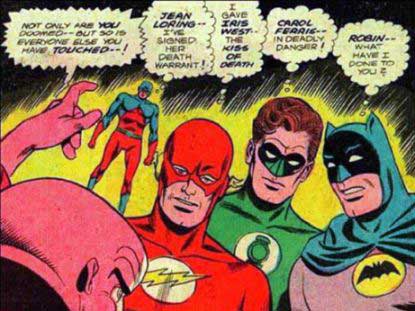
The recurring drama of the possibility that Batman and Robin are homosexual lovers has almost ruined the franchise twice, once in the 50's and 60's, and again in the 90's when Batman and Robin hit the silver screen in 1997. Film director Joel Schumacher, who is gay, introduced campy and homoerotic concepts in the film (such as including uncharacteristic nipples on Batman and Robins' costumes) which undermined the seriousness of the characters. Since that film, no media has depicted Batman and Robin as homosexuals or in campy way, although these elements remain a recurring yet harmless joke.

New Report Estimates LGB Population In U.S. At 9%
The Williams Institute at UCLA Law School, a think tank devoted to sexual orientation law and public policy, has released a report (pdf) which analyzes national demographic surveys to tease out interesting information about the national lesbian, gay and bisexual population.
From the Executive Summary:
Data from the 2008 General Social Survey (GSS) indicate that nearly 9% of adults either identify as gay, lesbian, or bisexual or report having had same‐sex sexual experiences as an adult. Although 90% of LGB people are out about their identity to other people, only 25% report being out to all of their coworkers in the workplace. The data show that bisexuals differ in several ways from those who identify as gay or lesbian, including being much less likely to be out or have a high school diploma and being much more likely to be women and/or racial or ethnic minorities.
Surveys that ask questions about sexual orientation and behavior are rare. Among the few surveys that ask these questions, few are representative of the US population. Even rarer is information about the coming out process from such surveys. As a result, little is known about how and if thinking of oneself as gay, lesbian, or bisexual, or experiencing same‐sex sexual behaviors and telling others about one’s sexual orientation or behavior varies by sex, age, race/ethnicity, and educational attainment.
The General Social Survey (GSS), conducted by the National Opinion Research Center at the University of Chicago, has monitored social and demographic changes in the United States since 1972. The 2008 GSS marks the first time that survey participants were asked about their sexual orientation (prior surveys had only asked about same‐sex sexual behavior). The 2008 survey also includes a module of questions (added with the financial support of the Williams Institute) directed at sexual minorities that ask about the experience of coming out, relationship status and family structure, workplace and housing discrimination, and health insurance coverage.
Other significant results that are included in the report are:
· 1.7% of adults self-identified as gay or lesbian and 1.1% self-identified as bisexual
· More than 3 in 4 lesbian, gay, or bisexual (LGB) adults say that they were first attracted to someone of the same-sex before they were 18 years old.
· Women are more likely than men to be LGB (4.6% vs. 2.9%). They are twice as likely to be bisexual than men (1.9% v. 0.7%, respectively).
· Younger people are more likely to be LGB. 7.2% of those aged 18-30 are LGB compared with 3.8% of those aged 30-54 and 1.4% of those aged 55 and older. (emphasis added)
· Gay men and lesbians are more likely than bisexuals to be out to at least some people (96% vs. 75%, respectively).
· Older people are much more likely to be in the closet . Adults over the age of 55 are 83 times more likely than those under 30 to have never come out to another person.
The author of the report is Williams Distinguished Scholar Dr. Gary Gates who says:· Bisexuals are more likely to be a racial/ethnic minority than heterosexuals, gay men, or lesbians. More than half of bisexuals are non-white compared to approximately 30% of heterosexuals, gay men and lesbian. The racial and ethnic characteristics of gay men, lesbians, and heterosexuals are similar to each other.
"These provocative findings demonstrate the challenge in understanding thecomplex relationship between sexual orientation identity and behavior.Given that nearly half of Americans still believe that homosexualrelationships are morally wrong, it is not surprising to find ambiguitybetween how people behave sexually and how they identify their sexualorientation."
Cross-posted from The Mad Professah Lectures.
Tuesday, October 5, 2010
Blaming The Victim For Gay Teen Suicide

Rob Tsinai over at Box Turtle Bulletin has created the above graphic to explain how heterosexual supremacists respond to reports of gay teen suicide.
Monday, September 20, 2010
Effeminacy. Too Feminine?
While I was browsing Twitter this morning, I saw a link to an article that claims that there should be a line between those who are effeminate (and male identifying) and homosexual and those who are effeminate and claim to be heterosexual. The article (found here), pictures Bill Kaulitz from the German band Tokio Hotel. Bill is the lead singer, and self-identifies as a heterosexual male. He does, however, have a very soft face, and can often be seen wearing eye makeup, which I've come to realize is a signifier of femininity.

So then, where do we draw the line? At what point does typically homosexual behavior make a heterosexual man seem gay? Who decides?

This is Bill. He doesn't, however, wear traditionally feminine clothing. He dresses in jeans and t-shirts, but he chooses to wear his hair long. I fail to see how this makes a person "too feminine to be straight."
Intrigued, I started thinking about the different ways that the media affects what people think of a person's sexuality. For example, Adam Lambert is openly homosexual, but his bass player, Tommy Ratliff (on the right), is heterosexual. During the "Glamnation" tour, there are multiple homoerotic moments between the two, and there are many different kisses throughout the night. Does this make Tommy Ratliff homosexual, or is it a part of the desire for more attention? Maybe it's just fun?

So then, where do we draw the line? At what point does typically homosexual behavior make a heterosexual man seem gay? Who decides?
Subscribe to:
Posts (Atom)